The Action
My Journal
A voice-first tool to log your training, capture your immediate reactions, and uncover patterns over time. It gives you the clarity to back your obsession.
Explore My Journal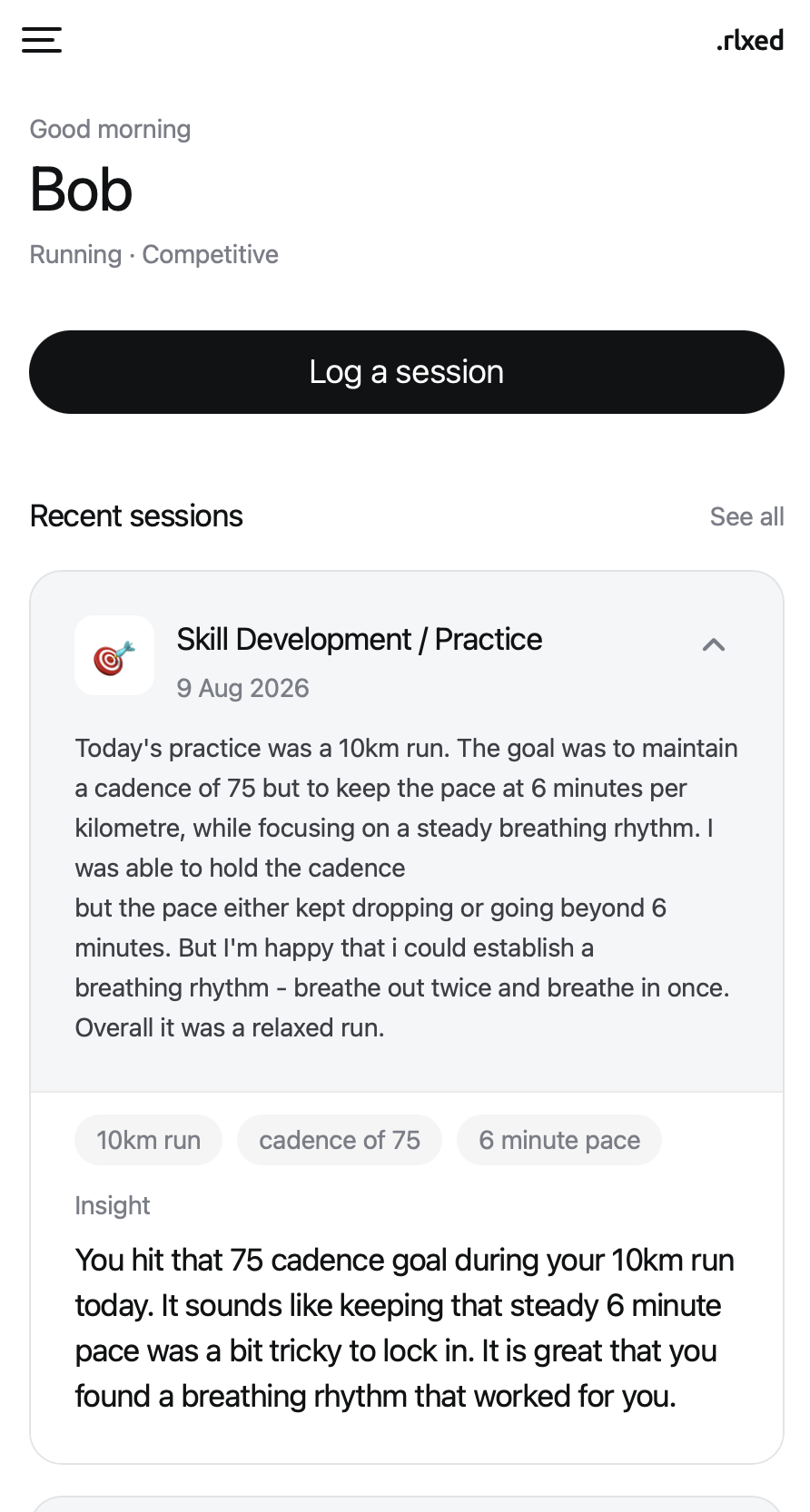
Accepting applications for Cohort #1 (15 spots only)
Reflect clearly. Understand yourself better. Grow with awareness.
My Journal and My Space - two connected tools designed to help athletes grow with more awareness and less noise.
One tracks what's working.
One helps you breathe when it matters most.
The Action
A voice-first tool to log your training, capture your immediate reactions, and uncover patterns over time. It gives you the clarity to back your obsession.
Explore My JournalThe Calm
A private, pressure-free sanctuary. No logging. No scores. Just a place to steady yourself after difficult moments and focus on one small adjustment.
Explore My Space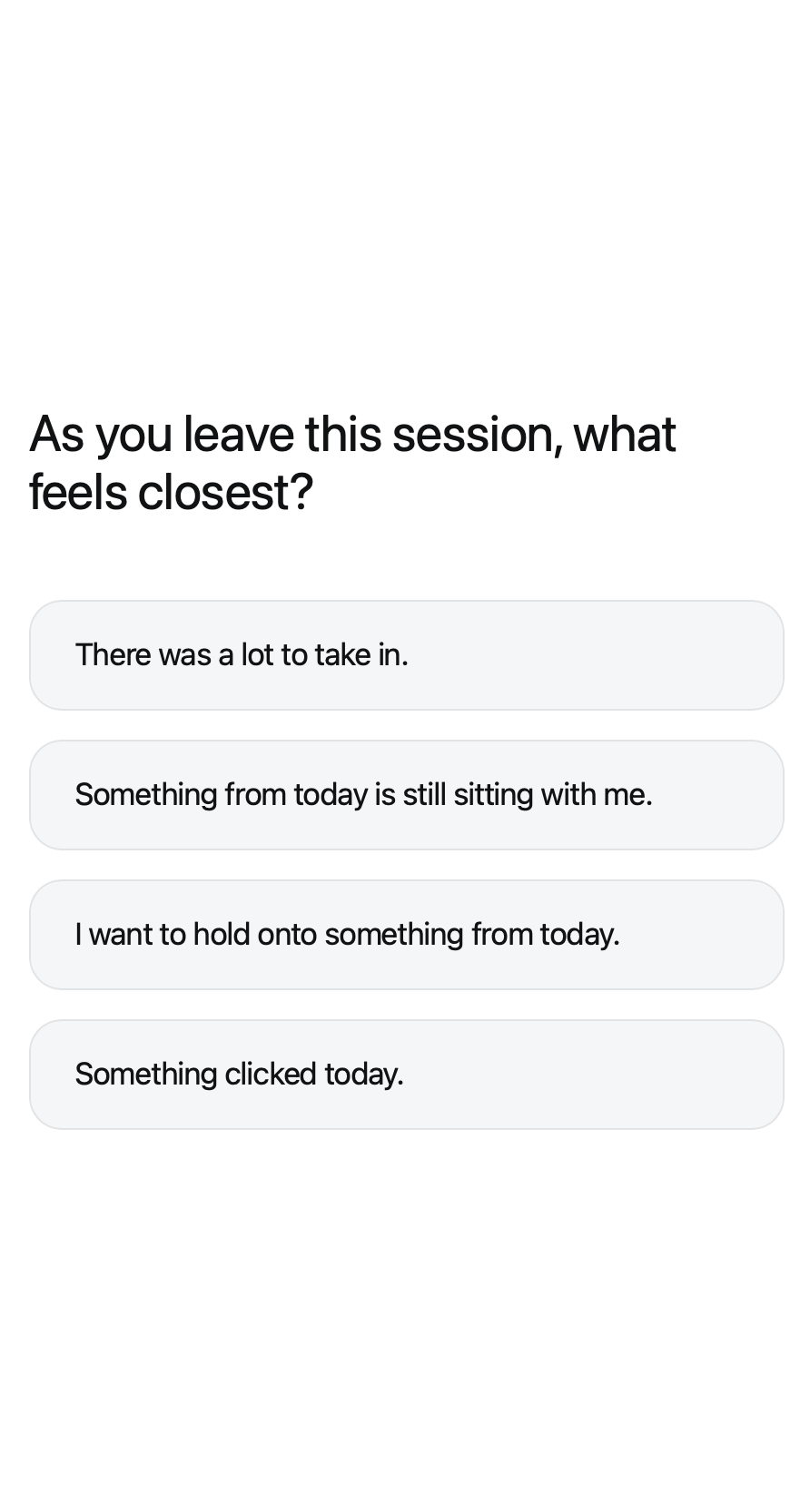
My Journal
You give 100% to every session. You analyze every decision. You're obsessed with getting better.
My Journal is the tool that actually gives you the clarity to back that obsession. Track your training, understand what's working, improve faster. Capture any session in under 60 seconds, and let rlxed connect your reflections to uncover patterns that are difficult to see on your own.
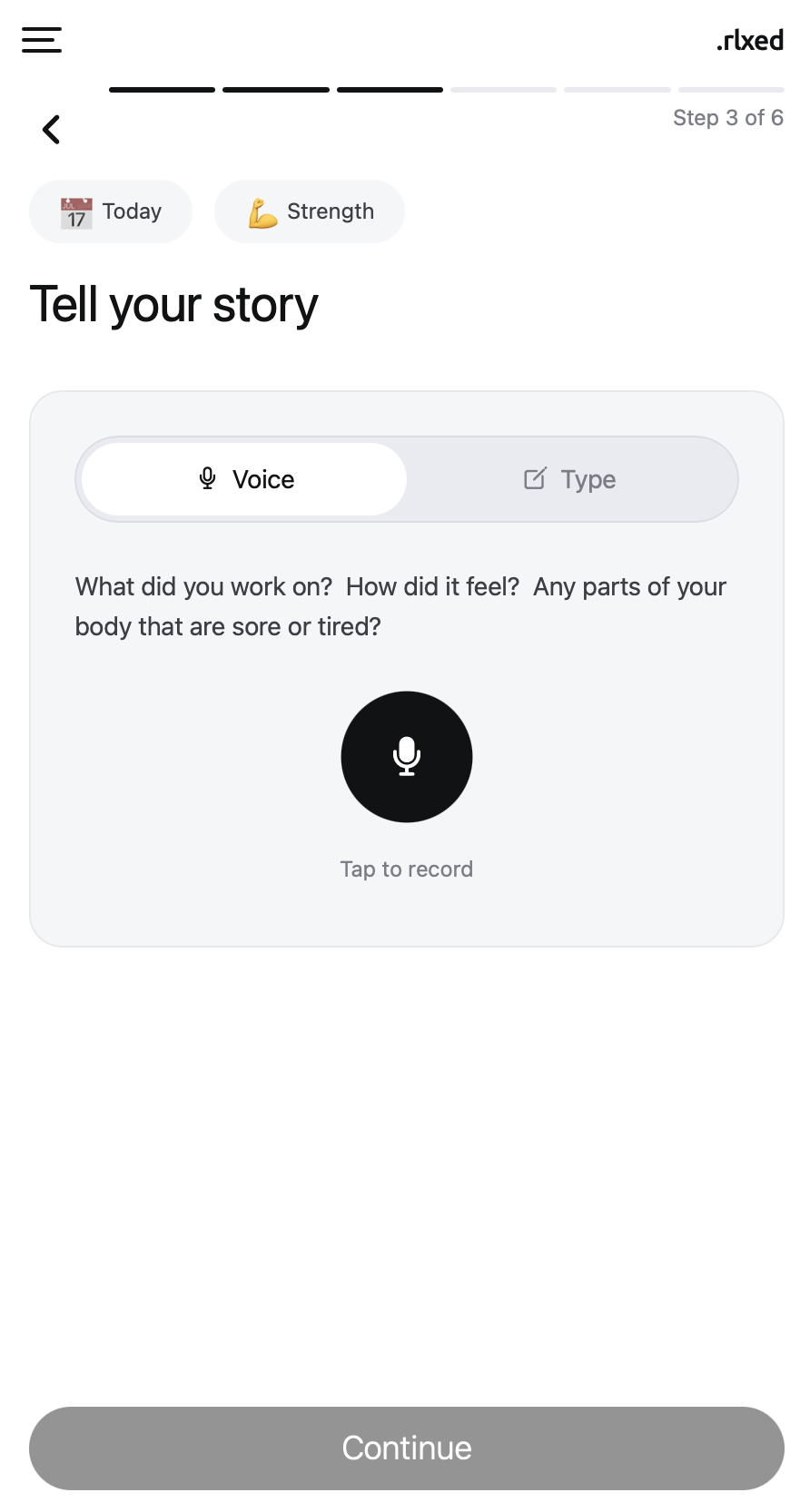
Log today's session via voice. Record execution, physical readiness, and psychological state in under 60 seconds.
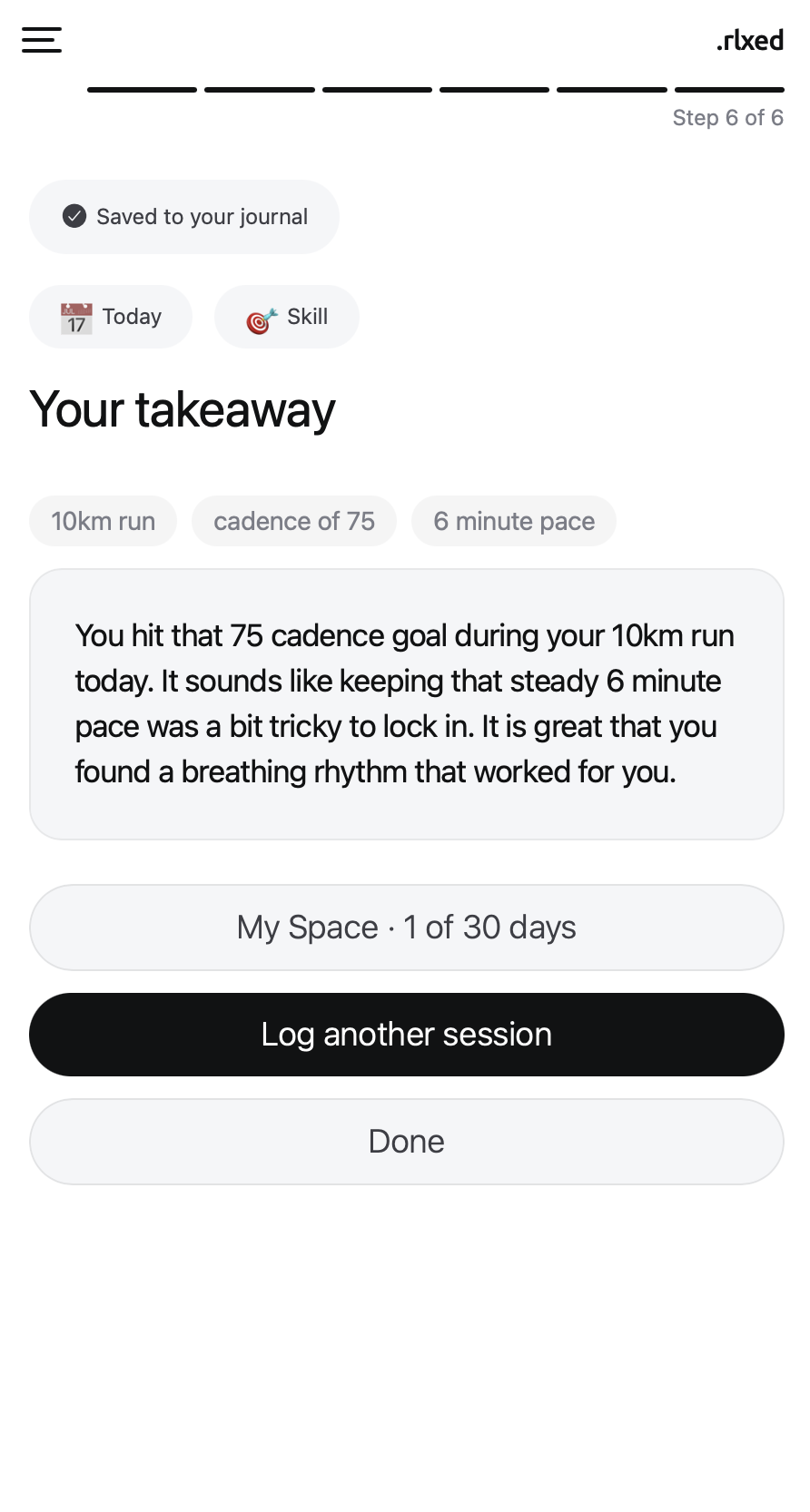
Move beyond manual entry with instant performance insights. Pinpoint trends and validate successful strategies.
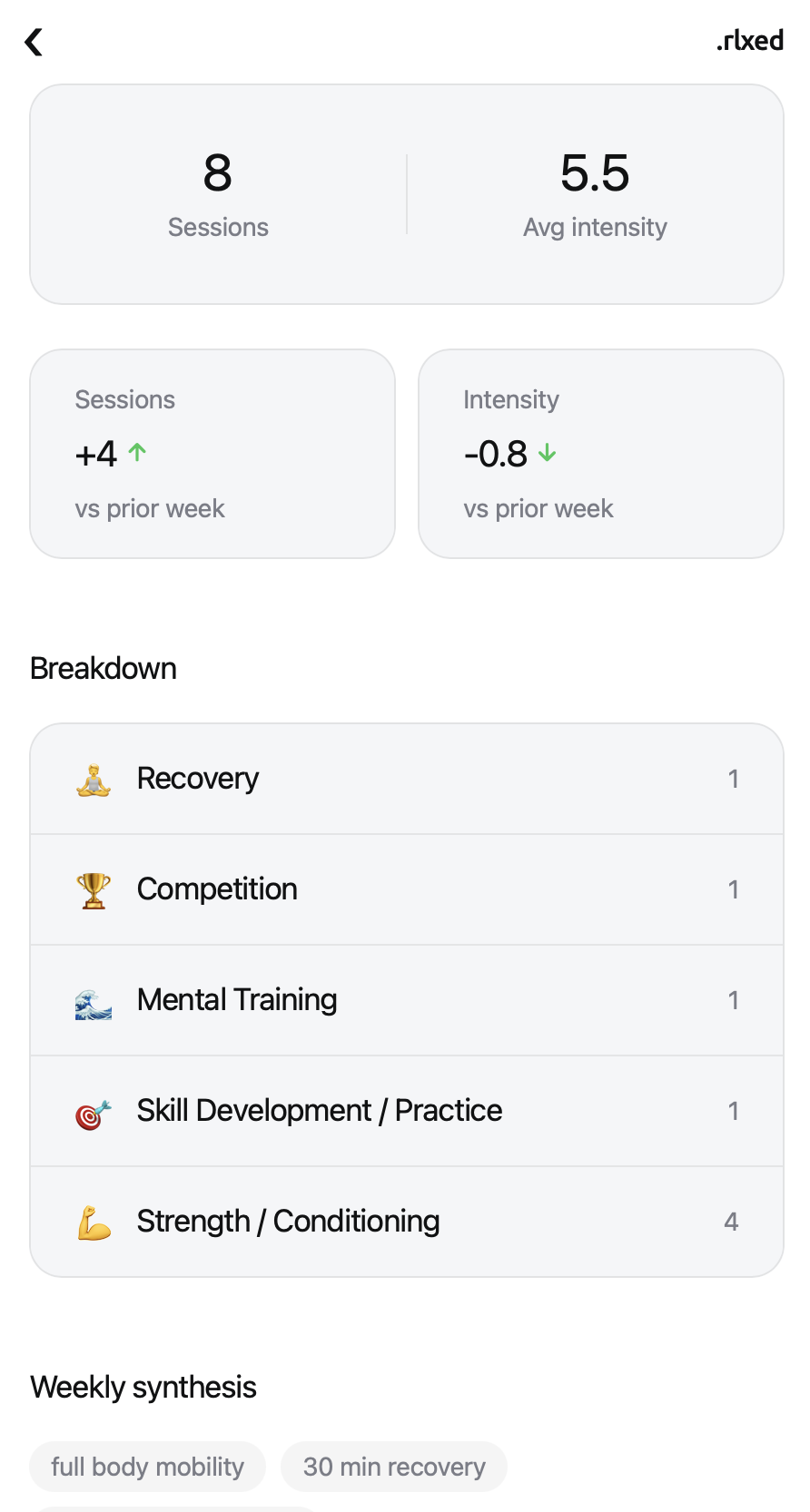
Recognize patterns over time with automated weekly synthesis of your training data. Get a high-level 7-day overview.
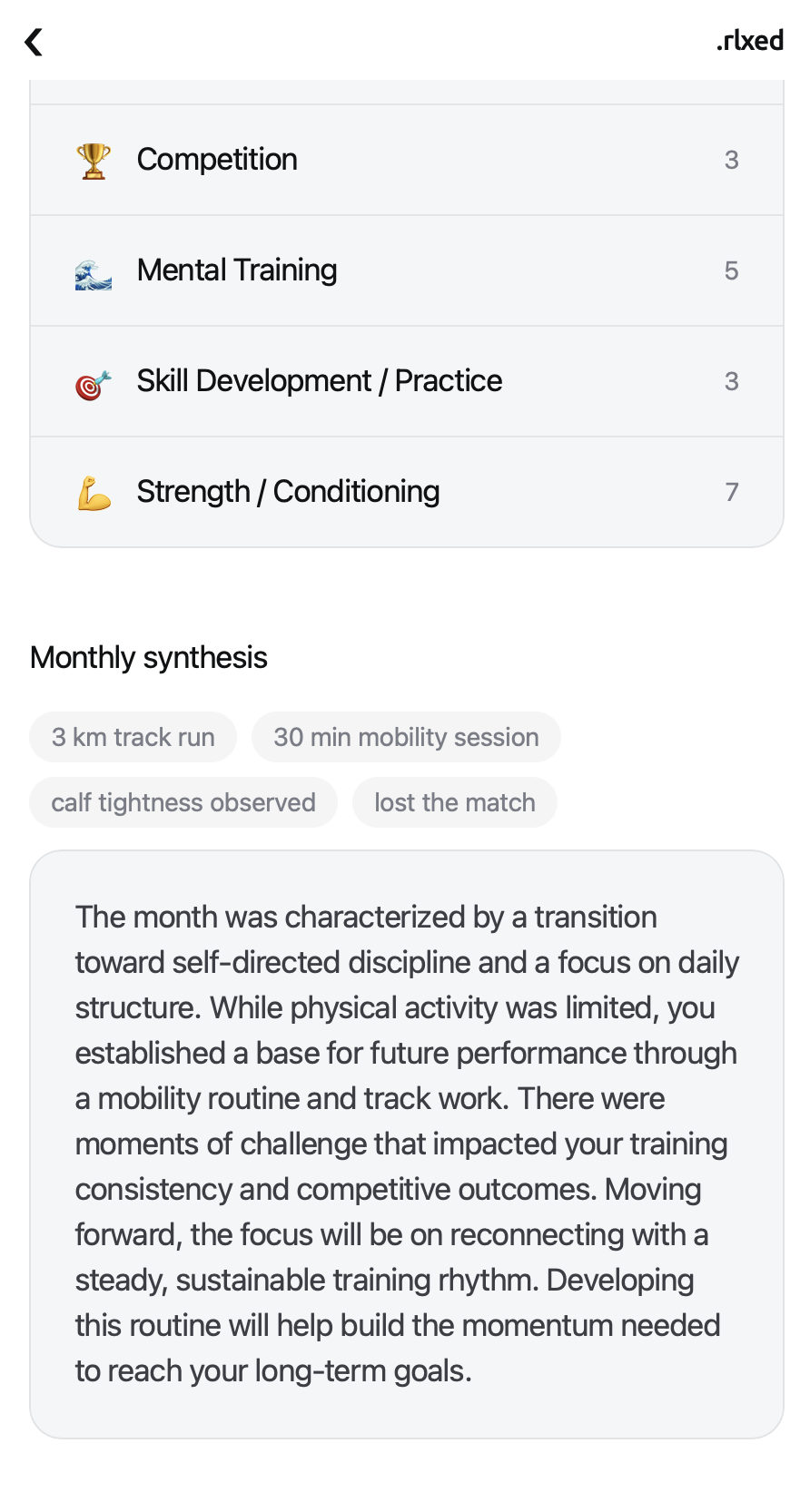
Zoom out to view macro-level trends. Understand long-term athletic trajectory and developmental cycles over 30 days.
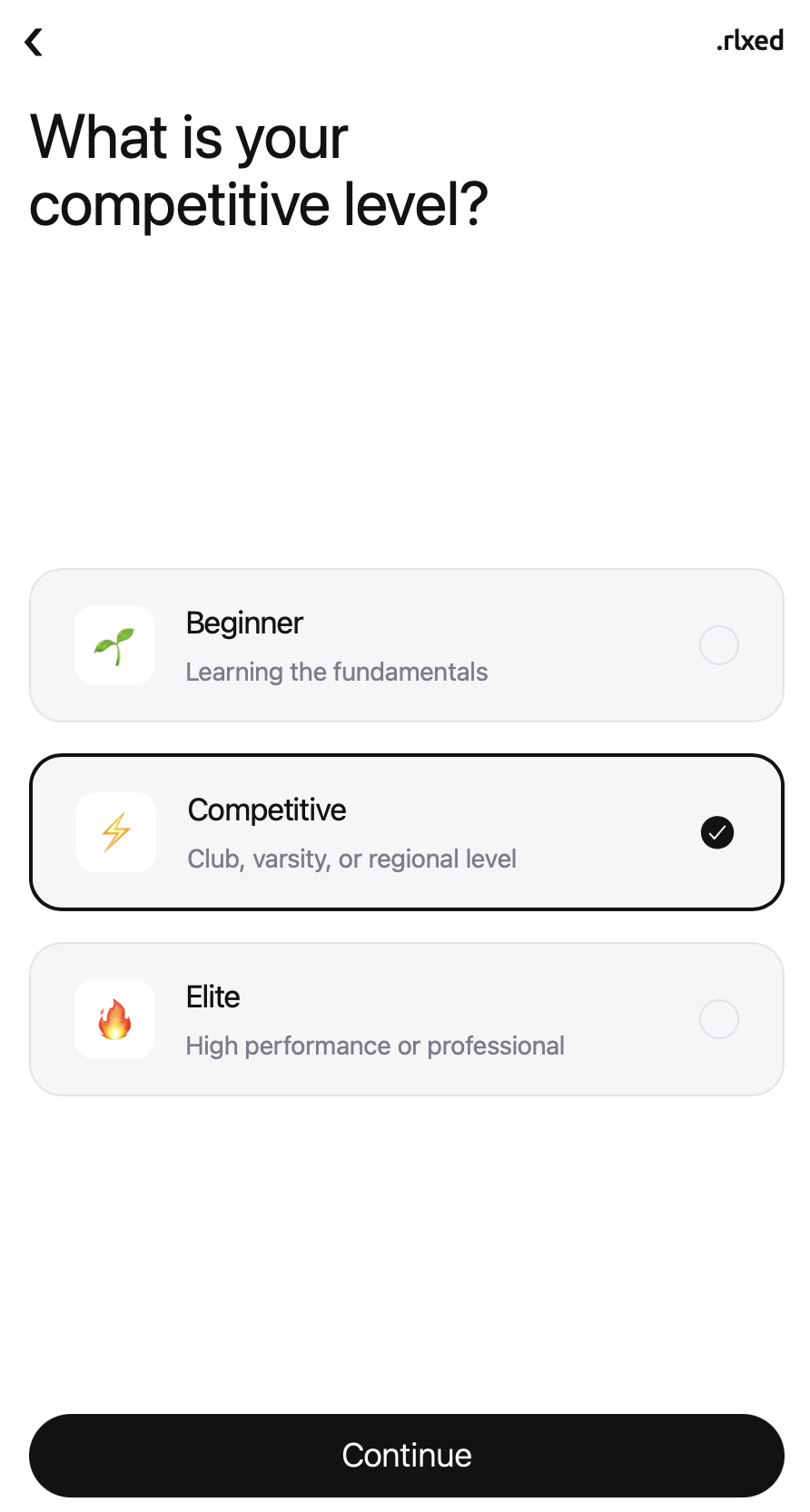
Turn reflections into actionable targets. Set sport-specific goals and track your progress against your actual training data.
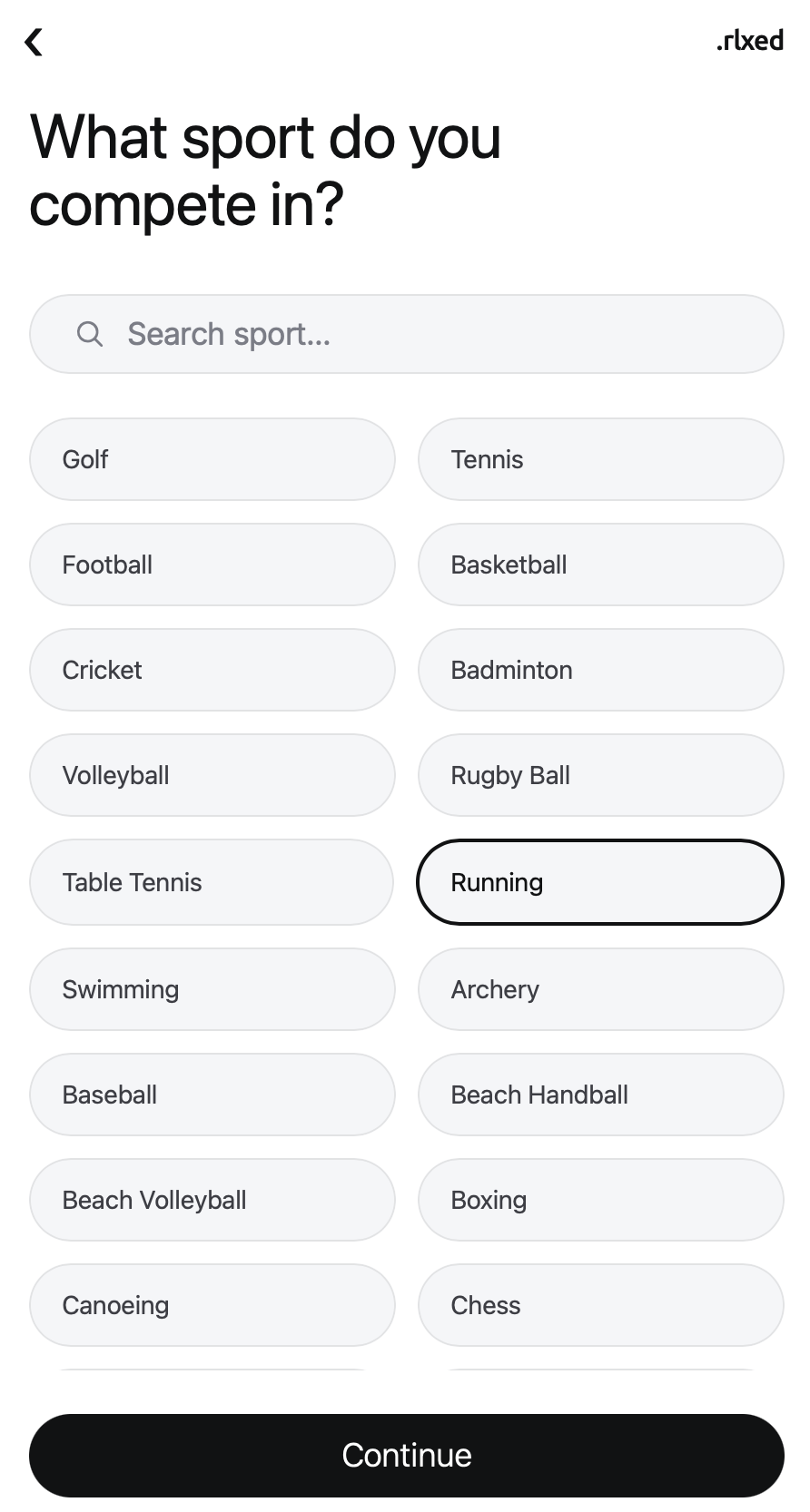
Supports 83+ sports. The system is fully sport-aware and adapts to your specific competitive context automatically.
Not a manual typing chore
it's voice-first and takes under 60 seconds.
Not a generic fitness tracker
it's sport-aware, adapting to the specific demands of your discipline.
Not just a diary
it actively uses AI to connect your reflections and uncover hidden performance patterns.
Not a replacement for your coach
it gives you and your coach better data about your internal state.
01
The Gap Bridged
Post-training fatigue degrades memory by up to 40% within an hour. Wearables track the physical output, but they completely miss the psychological context. By the time you sit down to type, the raw emotion and micro-physical cues are gone.
Why It's Important
Capturing your state in the moment prevents retrospective bias. It ensures your training log reflects exactly what happened, not how you rationalized it later.
In Practice
Consider an elite marathoner using voice-capture the second they stop sweating to log perceived exertion versus actual pacing data. If they wait until they get home, the raw feeling of hitting the "wall" is dulled, making it impossible to accurately correlate with their biometric data.
02
The Gap Bridged
Athletes generate gigabytes of unstructured data daily - heart rate, sleep, video, and thoughts. Human brains aren't wired to cross-reference a poor night's sleep with a drop in reaction time three days later, especially mid-season.
Why It's Important
It moves you from subjective guessing ("I just feel off today") to objective pattern recognition. The AI connects dots that would otherwise require a dedicated data analyst to find.
In Practice
Imagine a competitive swimmer whose AI insight reveals that their self-reported "feeling heavy" in the water always precedes a drop in stroke efficiency by 48 hours. The AI flags the verbal cue, allowing the coach to adjust the taper before the times actually drop.
03
The Gap Bridged
The daily grind creates tunnel vision. You can't see the forest for the trees. A single bad session feels like a downward trend, and a single good session feels like a breakthrough, leading to emotional rollercoasters.
Why It's Important
Contextualizes a single bad day within a broader 7-day trend. It prevents premature panic and stops you from drastically changing a training program based on a single outlier workout.
In Practice
A track athlete could use the 7-day synthesis to realize their "slump" was actually just a standard central nervous system (CNS) recovery phase following a heavy lifting block. Instead of pushing harder, they can trust the recovery process.
04
The Gap Bridged
Macro-cycles dictate peak performance, but athletes rarely review their month holistically. Burnout and overtraining don't happen overnight; they creep in slowly over weeks of compounding micro-stressors.
Why It's Important
While weekly views keep you on track, the monthly view protects your long-term health and seasonal peaking. It bridges the gap between daily training adjustments and seasonal athletic trajectory.
In Practice
A junior tennis pro might map their monthly confidence spikes against their training load. By doing so, they realize they perform best in the third week of a 4-week cycle, allowing them to sync their tournament schedule to peak precisely when it matters.
05
The Gap Bridged
Goals are often written in January and forgotten by February because they live in a silo, disconnected from the daily reality of training. They become wishes rather than operational targets.
Why It's Important
Closes the loop between intention and execution. It makes accountability data-driven rather than just emotional. If your goal doesn't align with your daily reflections, the system surfaces the discrepancy.
In Practice
Consider a basketball player who sets a goal to improve clutch free-throw shooting. rlxed connects this goal directly to their post-practice voice notes, tracking how fatigue impacts their shooting form over a 4-week period, making the goal dynamic and alive.
06
The Gap Bridged
A golfer's recovery day looks entirely different from a powerlifter's recovery day. Generic journaling apps force square pegs into round holes, asking irrelevant questions that waste your time.
Why It's Important
Precision. By understanding the specific metabolic and psychological demands of your discipline, the insights generated are actually applicable to your sport, rather than generic fitness advice.
In Practice
The system recognizes that a "light session" for a gymnast involves high neurological stress. It adjusts the AI's interpretation of their fatigue markers differently than it would for a "light session" in rowing, preventing false readiness scores.
While My Journal tracks what's working.
My Space helps you breathe when it matters most.
My Space
When training gets loud and competition gets louder, My Space helps you slow down, reset, and find yourself.
Access is earned. My Space requires no daily input. But to know when you need to pause, you first need to know your baseline. 30 days in My Journal builds the self-awareness required to actually benefit from a quiet space. It's not a coach, it's not therapy - it's a place to pause.
Not a journal
no entries, logs, or records to maintain.
Not a coach or therapist
doesn't diagnose, evaluate, or replace your support system.
Doesn't track performance
no streaks, leaderboards, or ratings.
Won't tell you what to do
you remain in control of the decisions you make.
Reflect on bigger patterns and breakthroughs without the pressure of streaks or scores.
Reset your mental approach when you need it. Make one small, focused adjustment.
Reconnect with why you compete. Navigate the moments between conversations with coaches.
01
The Gap Bridged
Athletes are conditioned to fix and optimize. This leaves no room to simply process a tough loss without immediately seeking a solution.
Why It's Important
Provides a pressure-free zone. Clarity comes from just naming what you're experiencing.
In Practice
Imagine a baseball player in a slump using My Space to name the frustration. By acknowledging the pressure without analyzing their swing, they dissolve the mental tension.
02
The Gap Bridged
When performance drops, the instinct is to overhaul everything. This total reset causes paralysis by analysis.
Why It's Important
Because not every moment needs fixing. Sometimes the most helpful thing is simply understanding what you're experiencing before deciding what to do next.
In Practice
A golfer who missed the cut steps into My Space to breathe, rather than immediately rebuilding their swing. They leave with one small perspective shift, not a mechanical overhaul.
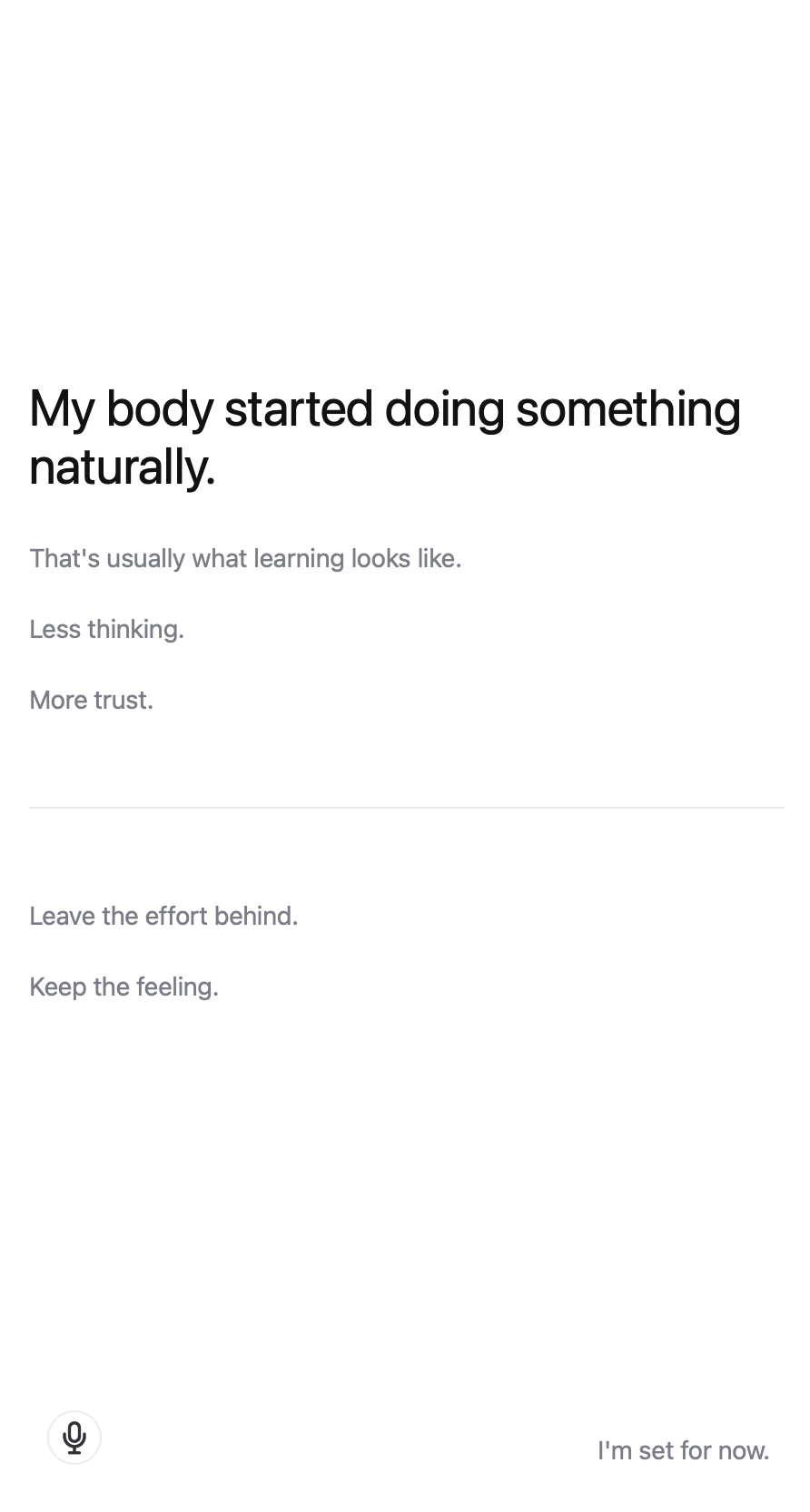
03
The Gap Bridged
Elite athletes are surrounded by opinions. The internal voice gets drowned out by external expectations.
Why It's Important
Re-centers your intrinsic motivation. A completely siloed environment where no one is grading you.
In Practice
A collegiate quarterback uses My Space the night before a game to separate their own desire to play from the external pressure of scouts.
Access is Invite-Only
Tell us about yourself and what you're working to improve.
Answers
Journal, Space, and how access works - straight answers, nothing extra.